SEO12 min read
What is an AI SEO agent? How it works, what it cannot do and how to choose one
An AI SEO agent does the repetitive half of SEO: research, drafts, audits and tracking. Here is the loop it runs, where it falls short, what Google's policies say and how to pick one without losing control of your site.
 BySemurai TeamThe people behind SemuraiPublished
An AI SEO agent is software that pursues an SEO goal on its own: it gathers search data, decides the next task, carries it out with real SEO tools and checks the result, while a person approves anything that changes a live site.
If you are wondering what an AI SEO agent is and how it differs from the AI writer you may already use, the short answer is the loop. A tool waits for your next prompt. An agent decides the next step itself. This guide covers how AI SEO agents work, what they do well, where they fall short (including what Google's own policies say about AI content), how an agent compares with an SEO tool, an agency and doing it yourself, and five questions to ask before you choose one. At the end we walk through a worked example in Semurai, our product.
What is an AI SEO agent?
An AI SEO agent is a language model connected to SEO data and tools, given a goal and allowed to choose its own next step. Three things separate it from a chatbot that can write about SEO:
- A goal, not a prompt. You state an outcome, such as "cover the cold brew topic for the US market", and the agent breaks it into tasks.
- Tools with real data. It calls keyword research, live Google results, a site crawler, Google Search Console and a rank tracker instead of guessing from what the model remembers.
- A loop with memory. It reads the result of each step, decides what comes next and keeps what it learned about your site, your brand and your audience.
In practice, AI agents for SEO cover five jobs: keyword research (finding and grouping the queries worth targeting), content (outlines, articles and on-page copy), technical audits (crawling for broken pages, missing titles, redirects and slow pages), rank tracking (daily positions and movers) and reporting (what changed and what to do next). Some products run one agent for all five. Others split the work across a team of specialised agents, the way an agency splits it between people.
How do AI SEO agents work?
AI SEO agents work in a loop: research, plan, write, audit and fix, track, learn, then start again with better information. Each round uses the output of the last one, which is what turns SEO automation into cumulative work instead of a pile of one-off answers.
Research
The agent pulls search volumes, keyword difficulty, the current Google results and competitors' pages, then groups keywords into topic clusters so that one page targets one search intent.
Plan
It turns the clusters into a content plan: which pages to write, which to update, in what order and for which channel. A good agent shows you this plan before it spends effort on it.
Write
It drafts outlines and articles against the plan, compares them with the pages already ranking (terms, headings, length, images) and suggests internal links to pages you already have.
Audit and fix
It crawls the site for technical problems: broken pages, duplicate or missing titles and descriptions, redirects, slow pages. Then it prepares fixes for a person to review and apply.
Track
It records daily positions for the keywords you care about and flags pages that climb, drop or sit just outside page one.
Learn
It feeds results back into the next round. A page stuck at position 12 becomes a refresh task, a cluster that works gets more pages, a sudden drop triggers a check.
The loop looks the same whether the agent is a single assistant, a workflow you wire up yourself in a tool like n8n, or a team of agents with separate roles. What differs is how much of it runs without you, and where you step in.
Can AI do SEO? What agents do well
Yes, AI can do a large share of SEO execution: the part that is repetitive, data-heavy and easy to check. Agents are strongest where the work has clear inputs and a measurable output.
- Research at volume. Pulling and clustering hundreds of keywords, reading the top results for each and spotting gaps against competitors takes an agent a fraction of the time it takes by hand.
- First drafts and refreshes. Outlines, briefs, article drafts, meta titles and descriptions, FAQ sections and product copy, all checked against what already ranks.
- Routine checks. Scheduled crawls, daily rank checks and "what moved this week" summaries that people tend to skip when they are busy.
- Connecting the dots. Noticing that two of your pages compete for the same keyword, or that an old post could rank again with a refresh and a few internal links.
- Consistency. Applying the same brand voice, checklist and structure to every page, every time.
What AI SEO agents cannot do
AI SEO agents cannot replace business judgment, first-hand expertise or relationships, and no honest vendor can guarantee rankings. These limits matter more than any feature list.
- Strategy judgment. An agent can rank opportunities by volume and difficulty. It cannot know that your margin is in wholesale, that a product line is being dropped or that your sales team needs leads rather than traffic, unless you tell it.
- Original expertise and E-E-A-T. Google's systems look for experience, expertise, authoritativeness and trust. Your test results, tasting notes, photos and customer stories come from you. An agent can structure them; it cannot honestly invent them.
- Earning links. Links and mentions come from relationships, PR and work worth citing. An agent can find prospects and draft outreach, but automated link schemes are a spam risk, not a strategy.
- Guarantees. Rankings depend on competitors, algorithm updates and your site's history. Treat any "page one guaranteed" promise as a red flag.
- Hallucinations. Language models still state wrong facts with confidence: invented statistics, outdated prices, links that lead nowhere. Agents grounded in tool data make fewer of these errors, not zero, so facts need a human check.
- Volume without value. Publishing hundreds of thin pages because the agent can write them is the fastest route into Google's scaled content abuse policy.
What Google's policies say about AI content
Google does not penalise content for being written with AI; it acts against content made mainly to manipulate rankings. In its February 2023 post, Google Search's guidance about AI-generated content, Google says it rewards high-quality content "however it is produced", and that using automation, AI included, with the primary purpose of manipulating rankings violates its spam policies. The same post points to E-E-A-T and to Google's guidance on asking who created a page, how and why.
Google's spam policies describe the risk in their section on scaled content abuse: generating many pages mainly to manipulate rankings rather than to help people, whatever method creates them. The first example listed is using generative AI to produce many pages "without adding value for users". The practical rule for any agent follows from that: every page should answer a real query better than what already ranks, and a person should check it before it goes live.
AI SEO agent vs SEO tool vs agency vs DIY
An AI SEO tool gives you data or a draft when you ask, an AI SEO agent decides and does the next task, an agency sends people to do it, and DIY means you build the workflow yourself. The right choice depends on your budget, your time and how much control you want to keep.
| Criteria | AI SEO agent | AI SEO tool | SEO agency | DIY (assistant or workflow) |
|---|---|---|---|---|
| What it does | Runs research, drafts, audits and tracking as a loop toward a goal | Answers one request: a keyword report, a content score, a draft | People plan and execute, often including links and PR | You prompt a general AI assistant or wire up a workflow tool |
| Who decides the next step | The agent proposes, you approve | You | The agency, with your sign-off | You |
| Speed | Usually faster than doing it by hand | Instant per request, slow overall because you drive every step | Days to weeks per deliverable | Depends on your free time |
| Typical cost | Entry plans we checked: Frase $49 and Search Atlas $99 a month billed monthly, Writesonic $79 a month billed yearly (checked October 2026) | Often part of an SEO suite subscription | Most common retainer $501-$1,000 a month in the Ahrefs survey (updated August 2024) | Assistant subscription, data tools and your hours |
| Strengths | Volume, consistency, works every day | Precise and predictable | Strategy, expertise, link building | Full control, cheap to start |
| Main risk | Unchecked publishing, generic content | You stay the bottleneck | Cost, slower feedback | Maintenance, scattered data, silent breakage |
| Best for | Small teams with more topics than hours | Specialists who want data, not delegation | Competitive markets and larger budgets | Technical marketers who enjoy building |
Agency pricing varies a lot by survey: Backlinko's pricing study (updated December 2025) puts the most common retainer at $1,001-$2,500 a month. The categories also blur. Some agencies now run agents in-house, and some agent vendors sell a human service tier on top. A setup that suits many small teams is an agent for execution plus a consultant for strategy a few hours a month. For a side-by-side of specific products, see our comparison of the best AI SEO agents in 2026.
How to choose an AI SEO agent
Choose an AI SEO agent by what it does without asking you, not by the length of its feature list. Before you start a trial, get clear answers to five questions.
Rollback deserves extra attention because few vendors document it. On the public pages we checked in October 2026, only Search Atlas (changes you can review, approve or roll back) and Rankable (a log of changes that can be undone) describe it. Rankability sends site changes as GitHub pull requests, which Git can revert. If an agent writes straight to your site and cannot undo, approval before publishing is your only safety net.
A worked example: an AI SEO agent team in Semurai
Here is the same loop in Semurai, the product behind this blog, on a demo project for a fictional roastery, Morrowfield Coffee Co. Semurai splits the work across a team of agents: Semur leads and hands out tasks, Keyres researches keywords, Tenko writes, Hime audits the site, Spynobi watches competitors and Rankmaru tracks rankings. (Somi and Dezaina, the AI marketing agents for social media and design, sit out this example.)
Ask for an outcome
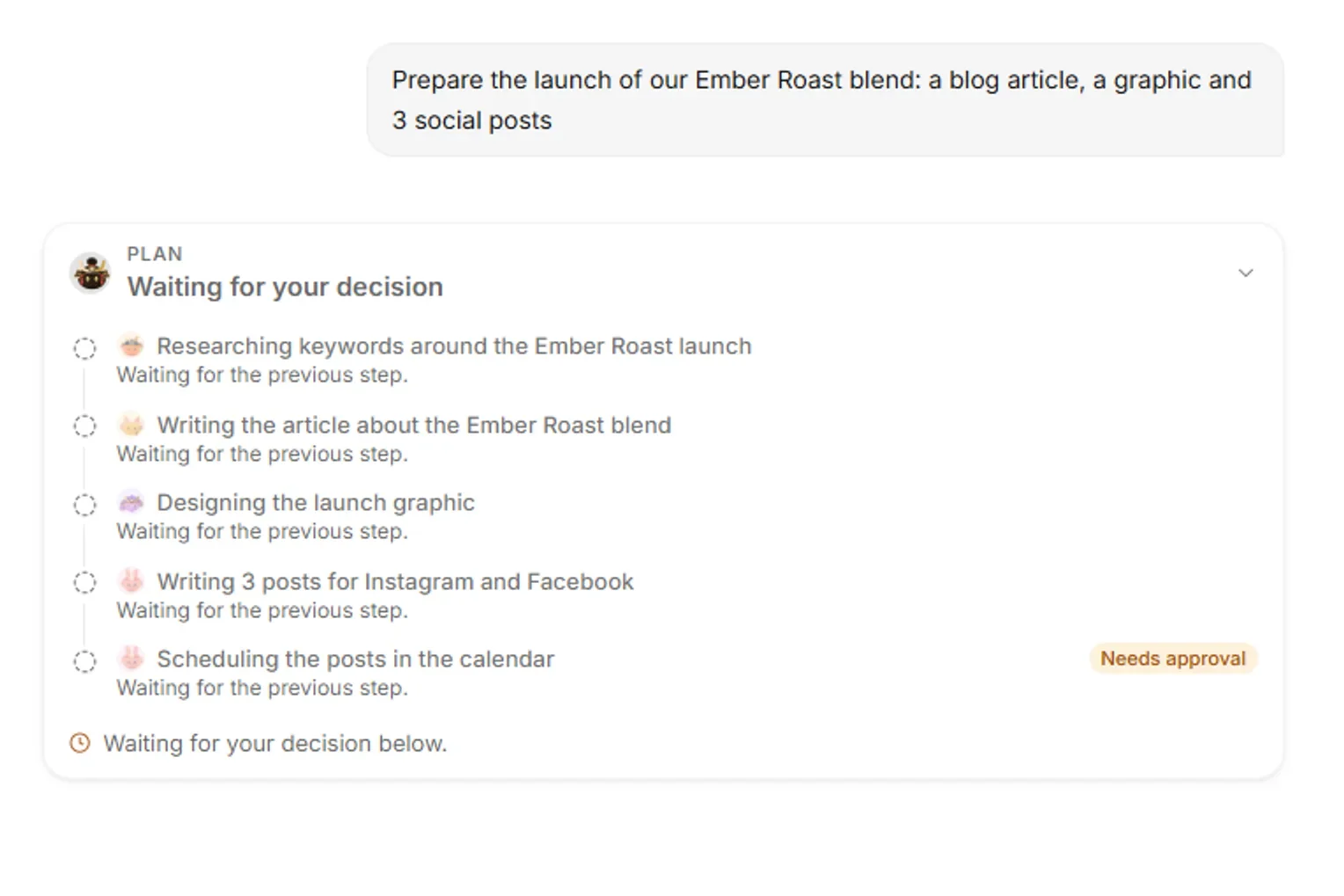
The request in chat is "Help us rank for cold brew in the US." Semur answers with a plan: who does what, and in which order. A plan holds up to six assignments, with up to three specialists working at once.

Demo project: Morrowfield Coffee Co. (demo data). Semur turns one request into a plan for the team. Approve once
Specialists never publish, schedule or change a live site themselves; they propose actions instead. Semur collects the proposals on one approval card, where you choose which actions run, adjust the content plan and approve or cancel.

Demo project: Morrowfield Coffee Co. (demo data). One approval card for the whole batch. Keyword research
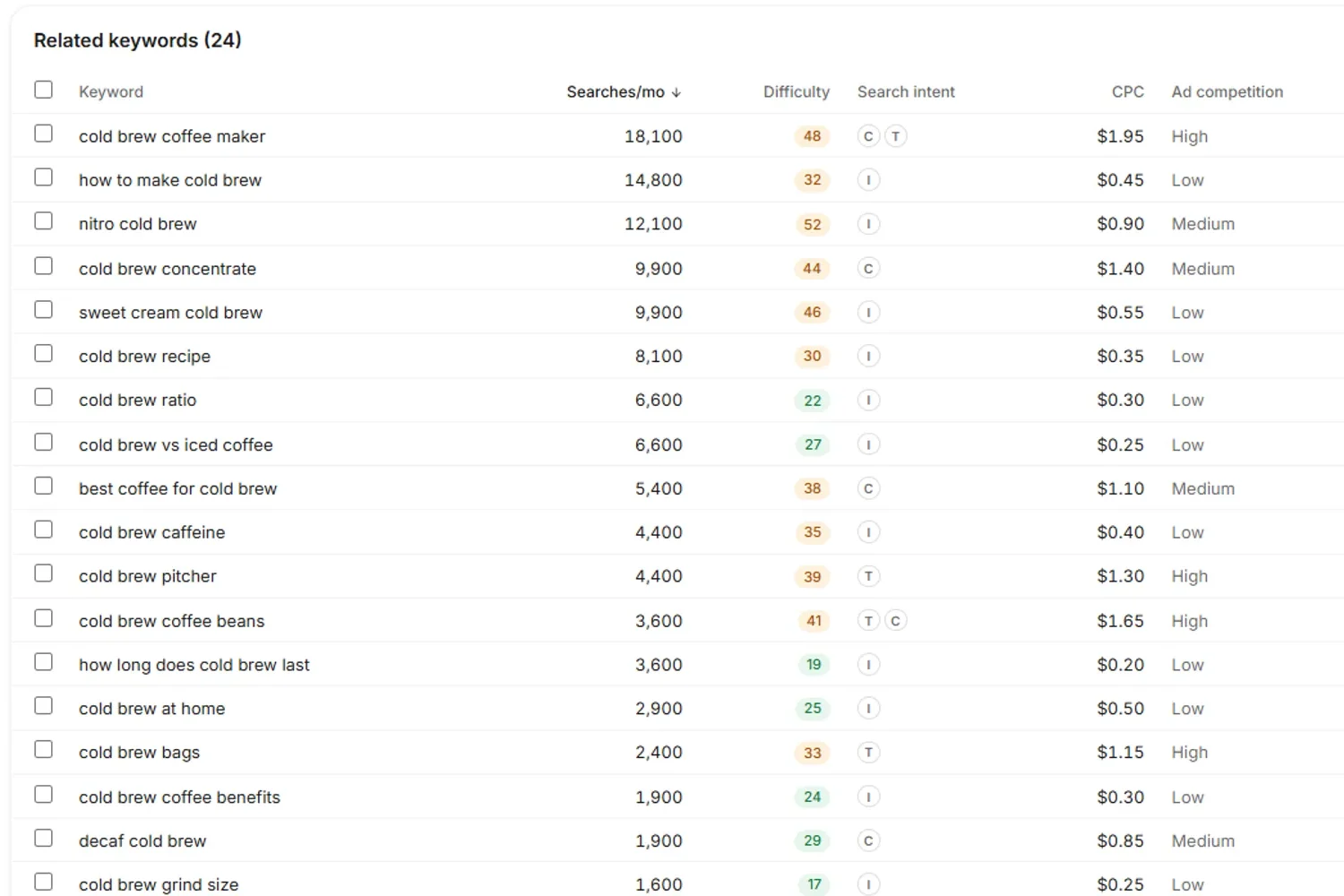
Keyres builds a keyword report for "cold brew coffee", groups it into three topic clusters and shows the Google results behind each one.

Demo project: Morrowfield Coffee Co. (demo data). Keyword clusters, with "cold brew coffee" at the top. Outline and draft
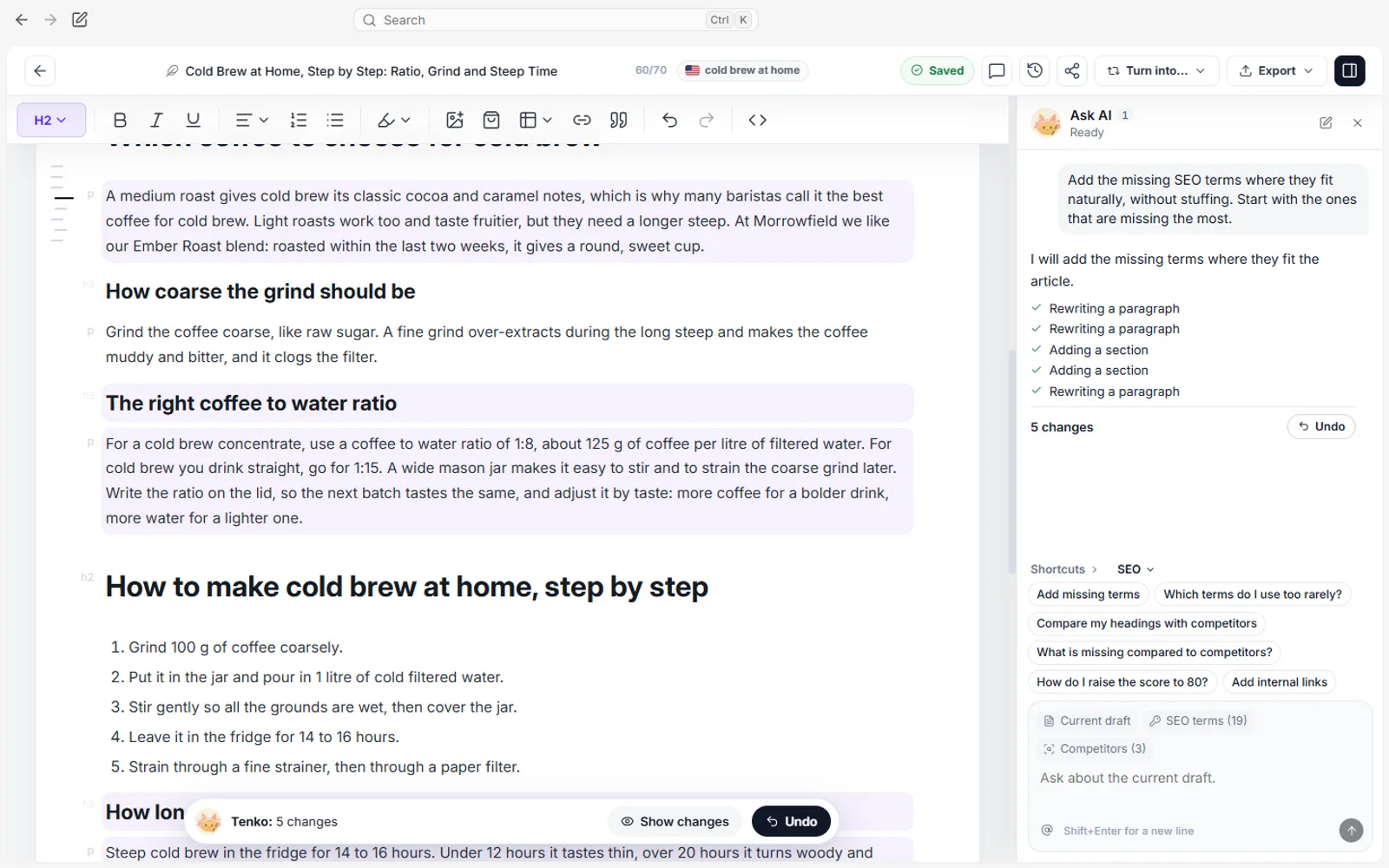
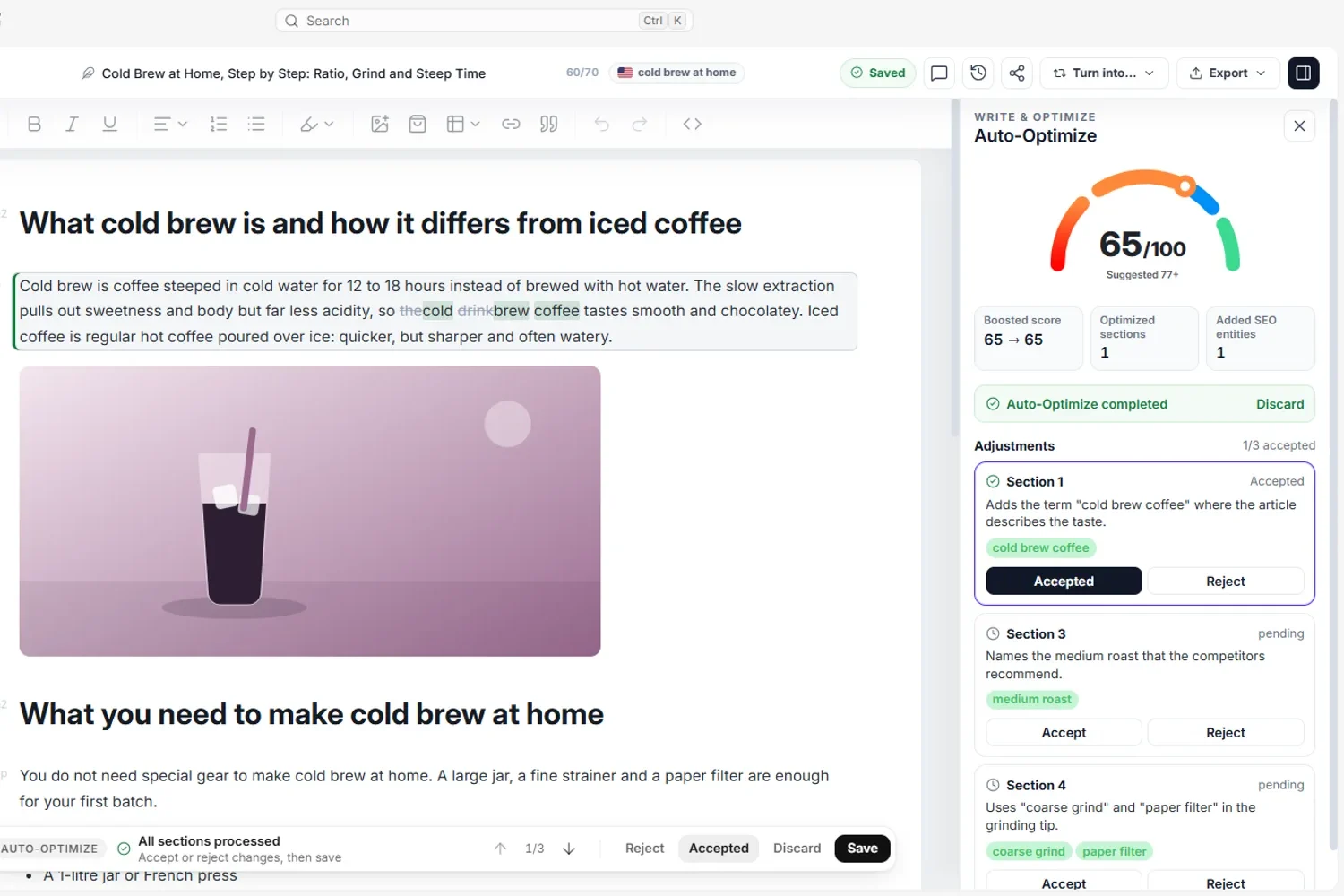
Tenko proposes an outline for "Cold brew at home, step by step", and you can approve or edit it before the article is written. In the SEO editor, the Content Score compares terms, word count and headings with the pages that rank, and counts your images, and internal link suggestions come from your own site.

Demo project: Morrowfield Coffee Co. (demo data). The draft's Content Score in the SEO editor. Audit and track
Hime runs the SEO audit and, on WordPress, prepares fixes for titles, meta descriptions and image alt text, which apply only after you approve them. Rankmaru proposes adding the cluster's keywords to the rank tracker, and you confirm; on paid plans they are checked daily, with a 30-day history.

Demo project: Morrowfield Coffee Co. (demo data). The cluster's keywords go to daily rank tracking.
RecordingTranscript
- On the home screen, write what you want to achieve
- Describe the goal, for example a new blend launch
- Semur plans the work and picks an agent for each step
- Check the steps of the plan before anything starts
- Keep Yes, continue and click Submit
- The agents get to work, the plan shows the progress
Publishing to WordPress, Shoper, PrestaShop or a connected channel waits for your click; the one exception is a campaign where you switch on autopublish yourself, which covers WordPress articles and posts. The agents prepare drafts inside Semurai, and you decide what goes live. There is a free plan, and paid plans start at $39 a month, or $29 a month billed yearly (see pricing).
Should you use an AI SEO agent?
Use an AI SEO agent if you have more topics, pages and checks than hours, and you are willing to review what it proposes. Pair it with a specialist, or skip it, if your market is won on links and reputation, or if nobody on the team has time to approve drafts and add first-hand expertise. Either way, let the agent do the legwork and keep the decisions yourself: that is the setup that works with Google's policies, not against them.
Frequently asked questions
What does an AI SEO agent do day to day?
Day to day, an AI SEO agent pursues an SEO goal on its own: it gathers search data, plans tasks, drafts content, audits the site and tracks rankings in a loop. Unlike a chatbot, it uses real SEO tools and decides the next step itself. A well-designed agent asks a person before it changes a live site.
Can AI do SEO on its own?
AI can do much of the execution on its own, including keyword research, drafts, audits and rank tracking. It cannot set strategy for your business, supply first-hand expertise or earn links through relationships. The safest setup lets the agent do the work and keeps a person approving anything that goes live.
Will AI SEO agents replace SEO specialists?
They replace a lot of repetitive tasks, not the specialist. Someone still has to set priorities, judge quality, add real expertise and own the results. Specialists who work with agents can cover more sites and topics in the same number of hours.
Are AI SEO agents safe for Google rankings?
They are as safe as what they publish. Google says it rewards helpful content however it is made, but mass-producing pages mainly to manipulate rankings falls under its scaled content abuse policy. Review every draft, add your own expertise and publish fewer, better pages.
Can I build my own AI SEO agent?
Yes. You can connect a general AI assistant to keyword data, a crawler and Google Search Console through a workflow tool such as n8n or your own scripts. Expect to spend time on data costs, prompts, error handling and maintenance. A ready-made agent trades some flexibility for much less setup.
What is the difference between an AI SEO tool and an AI SEO agent?
An AI SEO tool does one task when you ask, such as a keyword report or a content score. An AI SEO agent chains tasks toward a goal, decides the next step and reports back. The tool waits for you, while the agent proposes work and asks for your approval.