SEO18 min read
AI for SEO: how to use AI in SEO work and how to get cited in AI search
AI for SEO has two halves. One is using AI to do SEO work faster without hurting quality. The other is getting your pages found and cited by AI search. Here is a stage-by-stage workflow for the first, and what Google's documentation and the public studies say about the second.
 BySemurai TeamThe people behind SemuraiPublished
AI for SEO, often shortened to AI SEO, means two things: using AI tools and agents to do SEO work, such as research, briefs, drafts, audits and tracking, and optimizing your site so that AI search features, such as Google's AI Overviews and AI Mode, ChatGPT search and Perplexity, can find, trust and cite your pages.
Most guides to AI for SEO cover only one of those halves, but they are connected: the habits that keep AI-assisted content safe in Google (real expertise, checked facts, clear structure) also make a page worth quoting in an AI answer. This guide covers both.
What does AI SEO mean in 2026?
In 2026, "AI SEO" is used for two different jobs: doing SEO with AI, and doing SEO for AI search.
- SEO with AI. AI tools and agents take over research, drafting, checking and reporting, with the same goal as before: rankings and traffic.
- SEO for AI search. Making sure AI features that answer questions directly can reach your pages, understand them and cite them. You will see it called AI search optimization, GEO (generative engine optimization), AEO (answer engine optimization) or LLM SEO.
Google's own position is that the second job is still SEO. In its guide to optimizing for generative AI features (last updated 10 July 2026), Google says: "From Google Search's perspective, optimizing for generative AI search is optimizing for the search experience, and thus still SEO."
Part of the first job is now done by AI SEO agents, software that takes a goal and uses SEO tools to carry it out; our guide to what an AI SEO agent is covers how they work.
How to use AI for SEO: the workflow, stage by stage
Use AI for the parts of SEO that collect, compare and draft, and keep a person on the parts that need judgment, first-hand knowledge or a final check. The table covers ten stages.
| Stage | What AI does well | What a person must check |
|---|---|---|
| Keyword research | Pulls volumes, difficulty and the current results for hundreds of keywords, and suggests related queries and questions | That the keywords matter to your business and that the data comes from a real source, not the model's memory |
| Clustering | Groups keywords by search intent into topic clusters, so that one page targets one intent | That each cluster really shares one intent: look at the live results for two or three keywords in it |
| Briefs | Builds outlines from the pages that already rank: headings, questions, terms and length | That the brief adds something the ranking pages lack, instead of copying them |
| Drafts | Writes a first draft against an approved outline, in your brand voice, with an FAQ where it fits | Facts, numbers, names and links, plus the first-hand expertise, examples and photos only you have |
| On-page optimization | Compares a draft with the pages that rank (terms, headings, word count) and rewrites titles and meta descriptions | That the page still reads well for people: a higher content score is a hint, not a goal |
| Internal links | Suggests links from an index of your own pages, by topic, with anchor text | That each link helps the reader, and that anchors are not all the same exact keyword |
| Technical audits | Crawls the site for broken pages, redirects, missing or duplicate titles and descriptions, and slow pages, then sorts the issues | Which issues are worth fixing first, and every fix before it reaches the live site |
| Schema | Generates structured data (for example Article, BlogPosting or Product) from the page content | That the markup matches what the page visibly shows, that it validates, and that the type still earns a Google feature (FAQ rich results stopped showing on 7 May 2026) |
| Tracking | Checks rankings every day, flags movers and pages just outside page one | That location, device and keyword set match your real audience |
| Reporting | Summarises what changed, why it may have changed and what to do next | The conclusions: a correlation in a weekly report is not a cause |
One pattern runs through the whole table: AI is reliable when it works from real data (search volumes, live results, Search Console, your own crawl) and unreliable when it fills gaps from memory. To run parts of this on a schedule, our guide to SEO automation covers what to automate fully, with review or not at all.
Which AI tools fit which stage
No single tool is best at every stage. SEO data suites are strongest at research and tracking, content optimizers at briefs and on-page work, site crawlers at audits, and AI SEO agents at chaining the stages together. Our list of the best AI SEO tools sorts them by task, with prices checked in October 2026, and our comparison of the best AI SEO agents covers the products that run several stages on their own.
A worked example: the AI SEO workflow in Semurai
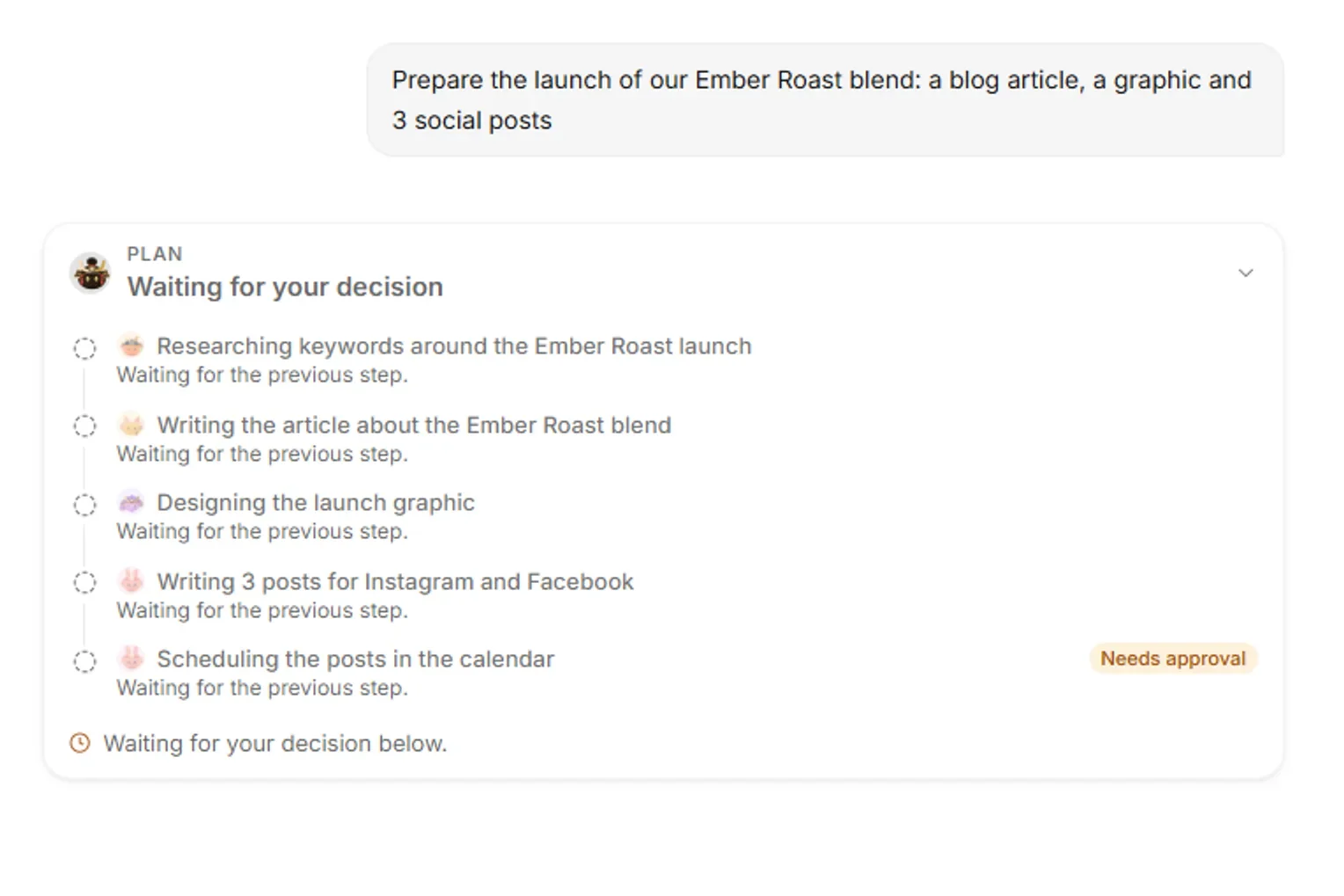
Here is the workflow in Semurai, the product behind this blog, on a demo project for a fictional roastery, Morrowfield Coffee Co. Semurai splits the stages across a team of AI agents led by Semur, and publishing waits for your approval. The one exception: a campaign where you switch on autopublish yourself, for the WordPress site and social channels you choose.
Research and clusters
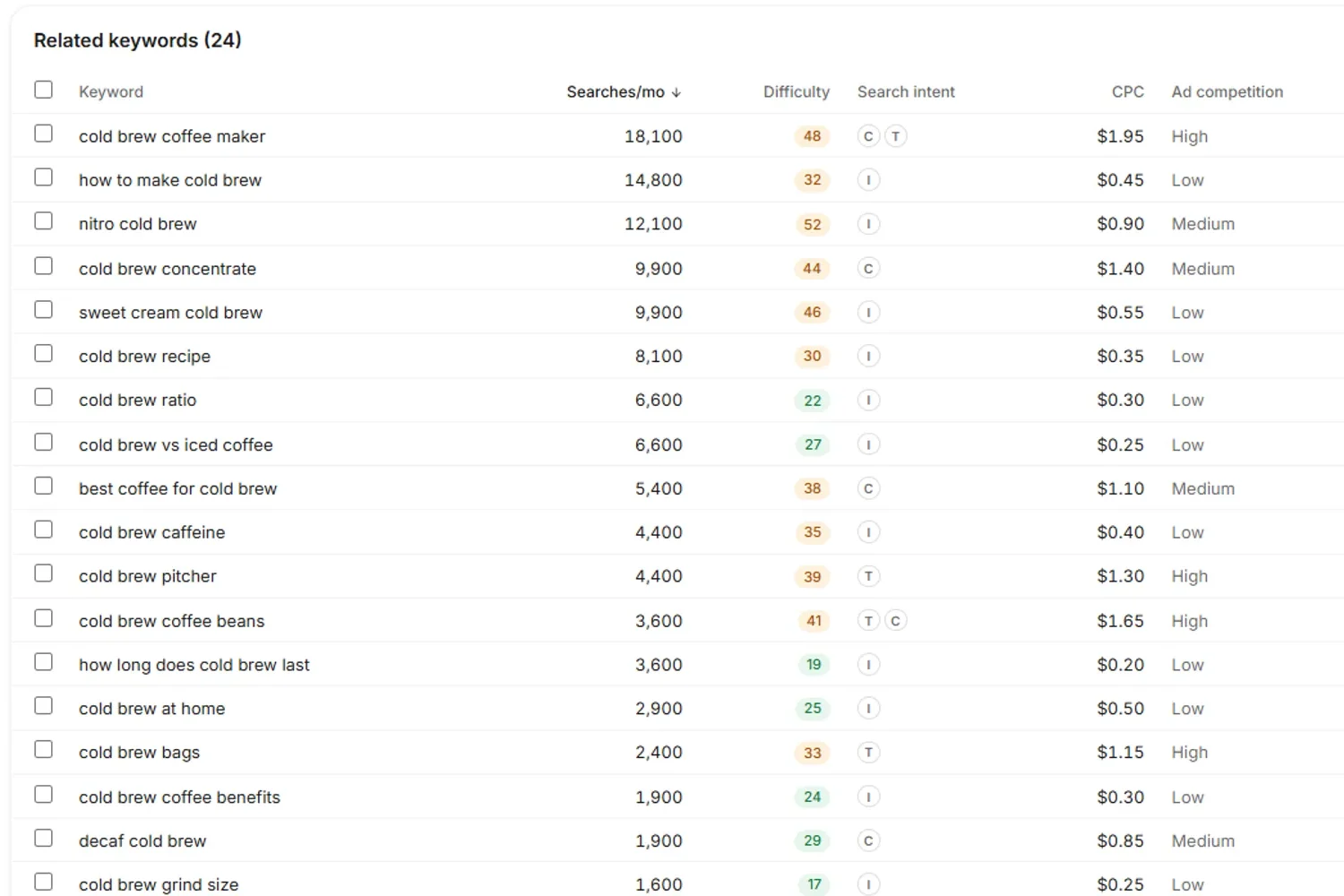
Keyres builds a keyword report for "cold brew coffee", groups it into topic clusters and shows the Google results behind each keyword, so you can check the intent yourself. Spynobi compares the site with up to four competitors to find keyword gaps.

Demo project: Morrowfield Coffee Co. (demo data). Keyword clusters, with "cold brew coffee" at the top. Review the outline
Tenko proposes an outline, and you can approve or edit it before the article is written (outline review can also be set to automatic).

Demo project: Morrowfield Coffee Co. (demo data). The outline, ready to edit before the article is written. Optimize, link and add structured data
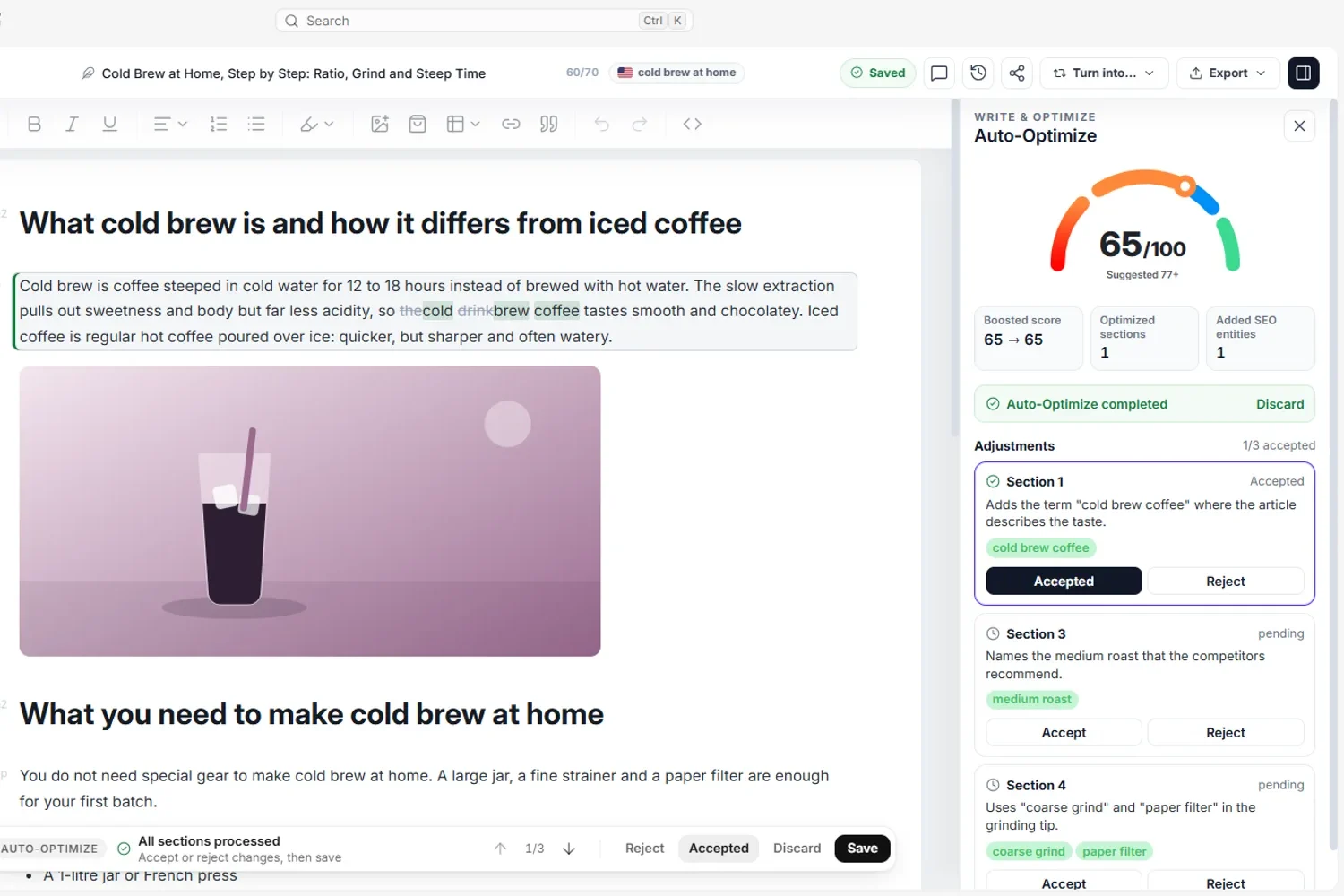
In the SEO editor, the Content Score compares terms, word count and headings with the top 10 results and counts your images. Internal link suggestions come from your own site, and FAQ questions from People Also Ask come with BlogPosting and FAQPage structured data that you can copy or send to WordPress. (FAQPage markup no longer earns a rich result in Google, but it still describes the questions on the page.)

Demo project: Morrowfield Coffee Co. (demo data). The draft's Content Score in the SEO editor. Audit and track
Hime runs the SEO audit with Semurai's own crawler and, on WordPress, prepares fixes for titles, meta descriptions and image alt text, applied only after you approve them. Rankmaru proposes adding the cluster's keywords to the rank tracker, and you confirm; on paid plans they are checked daily, with a 30-day history.
Publish when you decide
Publishing to WordPress, Shoper or PrestaShop waits for your click. The one exception: WordPress articles in a campaign where you switch on autopublish yourself. The agents prepare drafts inside Semurai, and Semur collects their proposals on one approval card where you choose which actions run.
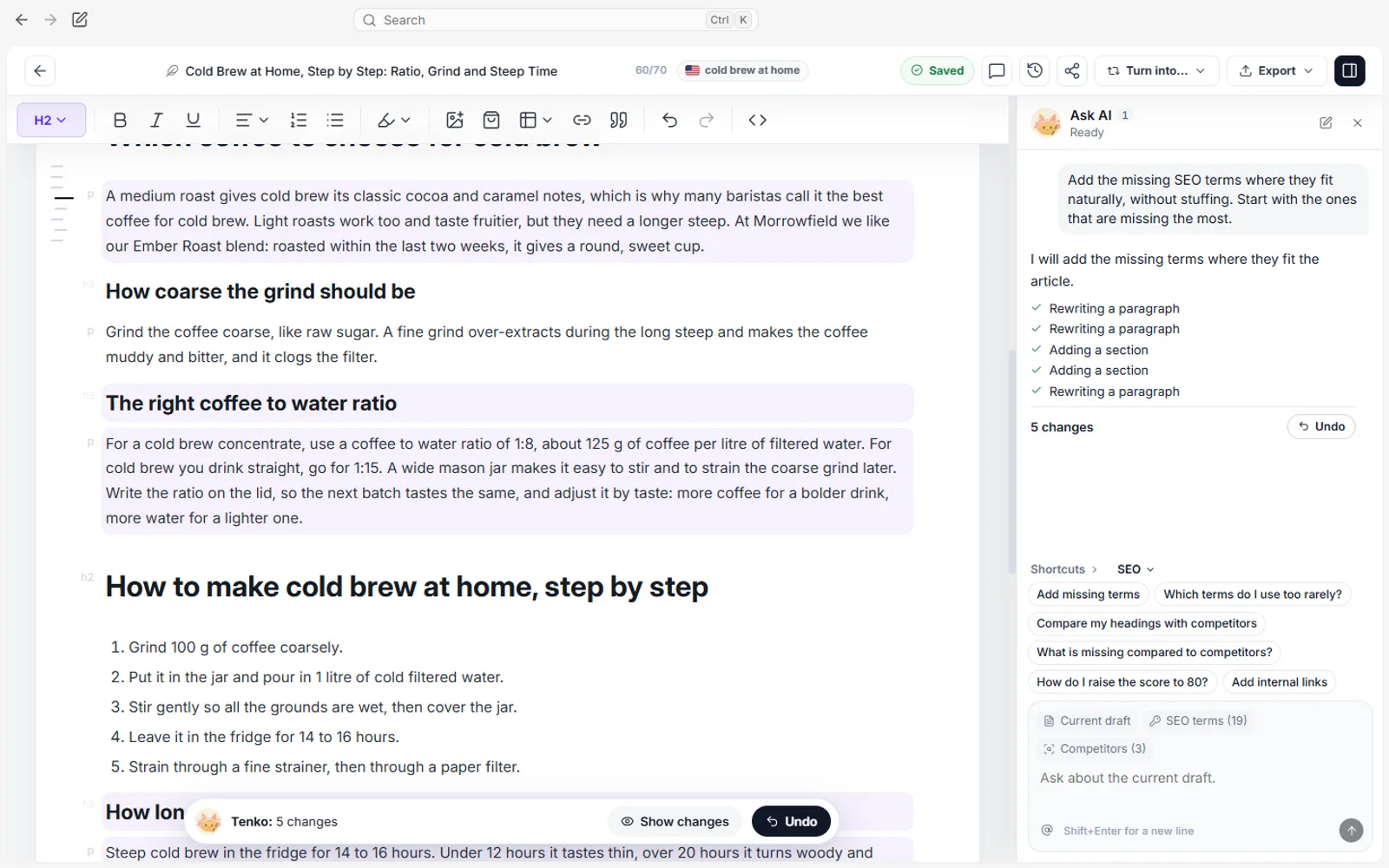
RecordingTranscript
- The Content score is 65: some terms are missing
- Open Ask AI and click Add missing terms
- Tenko adds the terms to the article live
- The Content score rises to 80+
- Show changes highlights what Tenko edited
The example covers the first half, AI doing the SEO work. For the second half, visibility in AI answers, use the reports covered below. There is a free plan, and paid plans start at $29 a month billed yearly or $39 billed monthly (see pricing).
Where AI hurts SEO
AI hurts SEO in three ways: when it is used to mass-produce pages without value, when it changes a live site in bulk without review, and when it states things that are not true. All three are about how AI is used, not about AI itself.
Google has said since its February 2023 post on AI-generated content that it rewards high-quality content "however it is produced". It acts against content made mainly to manipulate rankings.
- Scaled content abuse. Google's spam policies (last updated 28 August 2026) define scaled content abuse as "when many pages are generated for the primary purpose of manipulating search rankings and not helping users", and the first example is "Using generative AI tools or other similar tools to generate many pages without adding value for users". Google's generative AI search guide adds a newer twist: creating separate pages for every variation of a query, including the fan-out queries AI search runs in the background, "primarily to manipulate rankings or generative AI responses" also violates this policy.
- Unreviewed bulk changes. AI that rewrites hundreds of titles, redirects or templates at once can undo years of work unnoticed. Changes to a live site need an approval step and a way to undo them.
- Made-up facts. Google's guidance on generative AI content (last updated 1 October 2026) reminds site owners that "generative models don't retrieve facts" and asks them to "manually factcheck and review all AI-generated content for accuracy and trustworthiness before publishing". That review covers metadata too: titles, meta descriptions, structured data and image alt text.
The same guidance points e-commerce teams to rules they often miss: Google Merchant Center's policies for AI-generated content. AI-generated product images must carry IPTC DigitalSourceType TrainedAlgorithmicMedia metadata, and AI-generated title and description attributes must be specified separately and labelled as AI-generated. If your store sends a product feed to Merchant Center and uses AI for product copy or images, check how your platform and feed handle that labelling.
SEO for AI search: how AI Overviews, AI Mode, ChatGPT and Perplexity pick sources
AI search features pick sources by running searches of their own, reading the pages that come back and citing the ones they used, so a page has to be crawlable, indexed and useful to be considered. Google calls the first part grounding (retrieval-augmented generation) and describes a second technique, query fan-out: the model sends several related searches at once.
That makes each platform's crawler and index the entry point, as the table shows.
| AI search surface | Where sources come from | What to check | Where to measure |
|---|---|---|---|
| Google AI Overviews and AI Mode | Google's own index and ranking systems | Googlebot is not blocked, pages return HTTP 200, are indexed and can show a snippet, and Search Console's Search generative AI setting is not set to exclude | Search Console, which now has a Generative AI performance report |
| ChatGPT search | OpenAI's search crawler, OAI-SearchBot, and third-party search providers, including Microsoft (see below) | OAI-SearchBot is allowed in robots.txt and your pages are indexed in Bing | Referral traffic in your analytics |
| Perplexity | Perplexity's crawler, PerplexityBot | PerplexityBot is allowed in robots.txt | Referral traffic in your analytics |
| Microsoft Copilot and Bing AI summaries | Bing's index | Your site is verified in Bing Webmaster Tools and new URLs are submitted | Bing Webmaster Tools, AI Performance report |
Sources: Google's generative AI search guide, OpenAI's crawler documentation ("we recommend allowing OAI-SearchBot in your site's robots.txt file"), Perplexity's crawler documentation and Bing's AI Performance announcement (10 February 2026), read in October 2026. OpenAI and Perplexity separate their search crawlers from other bots, so decide per bot instead of blocking "AI" as a whole.
How often AI Overviews appear
How often AI Overviews appear depends heavily on the keyword set and the method: public estimates range from 18% of real Google searches to 87% of a business-oriented prompt set. An SEO.com analysis of 2.37 million US queries (first published July 2025, updated October 2026; no collection period given) found an AI Overview on 25.8% of them, rising to 38.7% for informational queries and 57.3% for queries of eight words or more. A Peec AI study of 500,000 prompts (one week in April 2026, a business-oriented prompt set from its own platform) put the average at about 87%. Earlier real-user data from Pew Research Center, based on the browsing of 900 US adults in March 2025, found AI summaries on 18% of their Google searches. The lesson: check your own keywords instead of borrowing a headline number.
What Google says about optimizing for AI Overviews and AI Mode
Google says there is nothing special to add for AI Overviews and AI Mode beyond the SEO basics: no AI text files and no special schema. The one new item is a Search Console setting that includes your site in its generative AI features by default. Its page on AI features (last updated 10 December 2025) states: "There are no additional requirements to appear in AI Overviews or AI Mode, nor other special optimizations necessary." It adds that "there's also no special schema.org structured data that you need to add."
The longer generative AI search guide (July 2026) goes further and lists things you can ignore for Google Search:
- llms.txt and other AI files. Google says you don't need "new machine readable files, AI text files, markup, or Markdown" because Google Search doesn't use them. Keeping an llms.txt file for other services "will neither harm nor help" your visibility in Google.
- Chunking content. There is no requirement to break pages into small pieces for AI, and no ideal page length.
- Rewriting for AI. AI systems understand synonyms, so you do not need to cover every phrasing of a query.
- Inauthentic mentions. Google says that seeking inauthentic mentions across the web "isn't as helpful as it might seem", because its AI features depend on both its core ranking systems and its spam systems.
- Structured data as an AI lever. It is not required for generative AI search, though it still helps pages qualify for rich results (Google stopped showing FAQ rich results in May 2026).
What Google does ask for is familiar: unique, non-commodity content with a first-hand point of view, a clear technical structure, a good page experience, images and video where they help, and up-to-date Merchant Center and Business Profile data for shops and local businesses. To be eligible at all, a page must be indexed and allowed to show a snippet, and the site must be included in Search generative AI features in Search Console (Settings > Search generative AI; inclusion is the default, and the same setting can exclude a whole site). You can limit what appears with nosnippet, data-nosnippet, max-snippet or noindex, and Google notes that "more restrictive permissions will limit how your content is featured in our AI experiences" (from its May 2025 post on AI search).
What the studies say about AI citations
The Ahrefs and Peec AI studies point the same way: AI search leans on what other sites say about you, not only on your own pages. Each study below uses a different method and none proves cause and effect, so read them as signals.
| Study | Date | Method in brief | Finding |
|---|---|---|---|
| Ahrefs: AI Overview brand visibility | 26 May 2025 | 75,000 brands, Spearman correlation between site factors and mentions in AI Overviews | Branded web mentions correlated at 0.664 with AI Overview visibility; referring domains at 0.295 |
| Ahrefs: "best" lists cited by ChatGPT | 4 Dec 2025 | 26,283 source URLs from ChatGPT answers to 750 "best X" prompts (software, products, agencies) | "Best X" blog lists were 43.8% of all page types cited; 79.1% of a 1,100-list sample with clear dates were last updated in 2025 |
| Peec AI: most cited domains | 31 Mar 2026 | 30 million sources directly cited by ChatGPT, Google AI Mode, Gemini, Perplexity and AI Overviews, US | Reddit, YouTube, LinkedIn, Wikipedia and Forbes led overall; ChatGPT leaned on Wikipedia and editorial sites, Google's AI features on YouTube and social sites such as Facebook |
| SE Ranking: llms.txt | First published 7 Nov 2025; current version dated 15 Oct 2026 | About 300,000 domains, correlation tests and an XGBoost model on AI citation counts | 10.13% of domains had an llms.txt file; no measurable link to how often they were cited |
| Aggarwal et al.: GEO | KDD 2024 | 10,000-query benchmark tested on a simulated AI engine and on Perplexity | Adding cited sources, quotations and statistics lifted visibility in AI answers by up to about 40%; keyword stuffing did not help |
Each has limits. Ahrefs stresses that correlation is not causation, Peec AI sells AI search monitoring and does not publish the counts behind its ranking, SE Ranking calls its results context-dependent, and the GEO paper tested a research benchmark, not today's production engines. SE Ranking and SEO.com (WebFX) also sell AI search tracking or optimization.
Our assessment of what this means in practice:
- Earn mentions, do not manufacture them. Being discussed in reviews, comparisons, forums and the press seems to matter more than another link, but Google warns that inauthentic mentions don't help.
- Get onto honest comparison lists. If "best X" lists make up a large share of what ChatGPT cites for buying questions, being fairly reviewed on the lists in your category is worth effort. Publishing your own list is fine if it is fair and names its author.
- Skip llms.txt as a ranking tactic. Google ignores it, and SE Ranking's study of about 300,000 domains found no effect on citations. Spend the time on crawlability and content.
- Keep important pages current. Most of the dated lists in the Ahrefs sample had been updated in 2025. Put a visible update date on pages you maintain and change it only when the content changes.
Content formats AI search likes to quote
In our assessment, AI search most readily quotes pages that answer a question directly, show data in tables and back numbers with a date and a source, and Bing gives similar advice for its AI answers. Google says you do not need to write in a special way for its AI features, so treat the points below as good writing for people that also happens to be easy to quote (supported by the GEO paper's results on sources and statistics).
- Answer first. Put a one or two sentence answer, or a 40-60 word definition, right under the heading, then the detail.
- Headings phrased as questions people ask. Use the wording from People Also Ask and from your own customers, not clever titles.
- Tables for comparisons. Prices, features and steps are easier to extract and read from a table.
- Dated numbers with sources. "18% of Google searches in March 2025, according to Pew Research Center" can be checked; "about a fifth of searches" cannot.
- Clear authorship and expertise. Name the author of the page and the first-hand experience it draws on. That first-hand angle is what Google calls non-commodity content.

Bing, IndexNow and ChatGPT search
If you want to appear in Microsoft Copilot and give ChatGPT search the best chance to find you, make sure Bing can index your site quickly: verify it in Bing Webmaster Tools and notify Bing of changes with IndexNow. Microsoft announced in May 2023 that "Bing is coming to ChatGPT as the default search experience". Today, OpenAI's help page on ChatGPT search says it "sometimes partners with other search providers" and lists Microsoft among them, without saying how the work is split. OpenAI also asks sites to allow OAI-SearchBot and to let its published IP addresses through their host or CDN, so cover both: allow OAI-SearchBot and keep your pages indexed in Bing.
IndexNow is a protocol that lets a site tell participating search engines that a URL was added, updated or deleted, instead of waiting for a crawl. Its site lists support from Microsoft Bing, Naver, Seznam.cz, Yandex and Yep; Google is not on the list. In its AI Performance announcement, Bing says "IndexNow helps keep information fresh across search and AI experiences".
The AI Performance report in Bing Webmaster Tools, in public preview since 10 February 2026, shows how often Microsoft Copilot, AI-generated summaries in Bing and "select partner integrations" cite your pages, which URLs are cited and sample grounding queries: the phrases the AI used to retrieve your content. Bing does not name the partner integrations, so do not read the report as a ChatGPT or Perplexity report; it does not include Google's AI features. For Google, use the Generative AI performance report in Search Console, which counts impressions in AI Overviews and AI Mode.
How to start: a checklist for AI and SEO
Start by fixing access, then improve the pages that matter, then measure; AI tools can help with every step, as long as a person signs off.
- Check access. Make sure robots.txt, your CDN and any firewall allow Googlebot, Bingbot, OAI-SearchBot and PerplexityBot, that Search Console's Search generative AI setting includes your site, that key pages return HTTP 200 and that nothing important is hidden behind scripts or logins.
- Connect the consoles. Verify your site in Google Search Console and Bing Webmaster Tools, and turn on IndexNow if your CMS or CDN supports it.
- Pick ten pages. Choose the pages that earn or should earn your business, and give each a direct answer under every heading, a table where data belongs, sourced and dated numbers and a visible author.
- Work on mentions. Find the lists, reviews and communities where your category is discussed and earn a fair place in them.
- Measure both halves. Track classic rankings and clicks, and check the AI reports in Search Console and Bing Webmaster Tools every month.
AI for SEO works best as a division of labour: AI does the collecting, comparing and first drafting, and people bring the judgment, the expertise and the reputation that both Google and AI answers reward. If you want that split handled by a team of agents that prepare the work and leave publishing to you, the worked example above shows how it works in Semurai.
Frequently asked questions
Where does AI save the most time in SEO work?
AI saves the most time in the stages that collect, compare and draft: keyword research, clustering, briefs, first drafts, on-page checks, internal link suggestions, audits, rank tracking and reports. Keep a person on fact checks, first-hand expertise, priorities and every change that reaches the live site. Work from real search data rather than the model's memory.
What is SEO for AI search called?
It is most often called GEO (generative engine optimization) or AEO (answer engine optimization), and sometimes LLM SEO. Google treats it as part of SEO. The basics are the same: crawlable, indexed, useful pages that other sites talk about.
How do I get my website into Google AI Overviews?
Google says a page must be indexed and eligible to show a snippet in Google Search, and your site must be included in Search generative AI features in Search Console, which is the default setting. Beyond that, write unique content with first-hand expertise, answer questions directly and keep the technical basics in order. The Generative AI performance report in Search Console shows how often your pages appear in AI Overviews and AI Mode.
Does llms.txt help with AI search?
Not for Google, which says it ignores llms.txt and similar AI files. An SE Ranking study of about 300,000 domains found no measurable link between having the file and being cited by AI systems. It does no harm if another service you care about uses it, but it is not a ranking tactic.
Is SEO dead because of AI search?
No. Google's AI features are built on its core ranking systems and cite pages from its index, and ChatGPT search and Perplexity also cite web pages they find through their own crawlers and search partners. What changes is that fewer searches end in a click, so being the cited source and being mentioned by other sites matter more.
How can I see whether AI search cites my site?
For Google, the Generative AI performance report in Search Console shows how often links to your pages appeared in AI Overviews and AI Mode. For Microsoft Copilot and Bing's AI summaries, the AI Performance report in Bing Webmaster Tools counts citations. For ChatGPT and Perplexity, check referral traffic in your analytics or use a dedicated AI visibility tracker.